Cloud vs On-Premise Food Safety Software
A clear-eyed trade-off analysis for food manufacturers choosing deployment model. The cases where cloud wins, the rare cases where on-premise still makes sense, and the security myths that cause manufacturers to over-pay for legacy architecture.
For Most Food Manufacturers, Cloud Wins
This is a buyer's guide written by a cloud-native vendor (QTRACA is cloud-only), so we're not pretending neutrality. But the analysis below is the analysis we'd write for any reasonable buyer evaluating this decision, including buyers who end up at on-premise vendors.
The short answer: for 95% of food manufacturers in 2026, cloud is the right choice. The remaining 5% have legitimate on-premise requirements — air-gapped facilities, specific data residency mandates, or legacy system integration that genuinely can't reach the cloud. Outside those scenarios, on-premise is usually chosen for reasons that feel like requirements but aren't: data sovereignty assumptions that don't survive scrutiny, IT preferences for control, or vendor relationships from the pre-cloud era.
The rest of this guide is the long answer: the trade-off matrix that justifies the short answer, the security myths that distort the decision, and the genuine cases where on-premise is still the right call.
Cloud vs On-Premise: Side by Side
| Criterion | Cloud | On-Premise |
|---|---|---|
| Deployment time | Days to weeks. Account provisioned in hours; HACCP plan loaded in 2-6 weeks. | Months. Server procurement, installation, configuration, IT testing, then HACCP plan loading. |
| Upfront cost | Low to zero. Monthly subscription; no hardware to buy. | High. Software licence ($20K-$100K typical), server hardware ($5K-$15K), implementation services. |
| 5-year TCO (SMB single-site) | $10K-$30K typical. Linear, predictable. | $50K-$150K typical including IT staff time and upgrade cycles. |
| IT burden | Minimal. Vendor manages servers, patches, backups, security. | Significant. Your IT manages all of the above plus upgrade cycles. |
| Updates | Continuous. Multiple per week, no downtime, automatic. | Periodic. Every 6-12 months with planned downtime and testing. |
| Multi-site | Native. Same login, same data, same software across sites. | Complex. Either separate installations per site or central server with VPN access. |
| Mobile access | Native. PWA installs on tablets and phones; works offline. | Variable. Depends on vendor's mobile strategy; often a separate licence cost. |
| IoT sensor integration | Native. Sensors stream to cloud, data available everywhere. | Complex. Sensors need to reach an on-site server; multi-site adds VPN complexity. |
| Disaster recovery | Built in. Backups, geographic redundancy, automatic failover. | Your problem. Backup strategy, off-site copies, recovery testing — all on you. |
| Security patches | Applied within hours of release. | Applied when your IT team gets to them. Often months behind. |
| Data export | Self-serve. CSV, Excel, PDF formats from the UI. | Usually requires IT involvement and vendor cooperation. |
| Audit defensibility | Strong. Tamper-evident records, full audit trail, immutable timestamps. | Variable. Depends on local IT security and backup policies. |
The pattern: on-premise wins on data control (you can physically see the server) but loses on everything that matters operationally. The data control advantage is usually illusory once you examine what your IT setup actually delivers vs what a cloud provider delivers.
The Cloud Security Argument, Examined
The most common reason food manufacturers choose on-premise is a security assumption: "our data is safer on a server we control." This assumption rarely survives examination.
What cloud security actually looks like
Reputable cloud food safety vendors run on AWS, Microsoft Azure, or Google Cloud. These providers maintain SOC 2 Type II certifications, ISO 27001, 24/7 security operations centres, automated threat detection, network segmentation, encryption at rest and in transit, and physical data centre security with biometric access and round-the-clock guards. The cloud vendor (your QMS provider) layers application security on top: role-based access control, audit logging, tamper-evident records, automated penetration testing.
What on-premise food safety security usually looks like
A server in a back office or IT closet. Windows or Linux patches applied when IT has time. Backups (hopefully) running to a NAS in the same building. Physical security: a door lock. User access: shared passwords on a sticky note in the quality manager's office (this is depressingly common). Penetration testing: never. Security audits: only when a customer requires one.
The honest comparison
For 99% of food manufacturers, the cloud vendor's security is dramatically stronger than what you can implement on-premise. The "we control our data" argument is emotional, not technical. The genuine exception: organisations with dedicated security teams, formal pen-testing programs, and security budgets that exceed what cloud vendors charge in subscription fees. That's typically very large enterprises — not the SMB food manufacturers who most often raise the cloud security concern.
Three Legitimate Scenarios
1. Air-gapped facilities
Some defence-adjacent manufacturers, certain government operations, and a small number of specialised facilities operate without internet connectivity by design. On-premise is the only option. This is rare in commercial food manufacturing but exists.
2. Specific data residency mandates
Most data residency concerns are satisfied by cloud vendors with regional data centres (AWS Sydney, Azure Australia, Google Sydney for AU/NZ; equivalent options in other regions). Genuine cases where cloud can't satisfy residency requirements are rare. The exception: some government contracts and defence supply chains have explicit on-premise mandates.
3. Legacy system integration that can't reach the cloud
Some on-premise ERP systems, PLC controllers, or legacy MES platforms cannot talk to cloud APIs and aren't going to be replaced any time soon. If your operational stack is fundamentally on-premise and the food safety platform needs to integrate at a low level, on-premise QMS may be necessary. This is real but increasingly rare as modern PLC and ERP vendors expose cloud-compatible APIs.
Outside these three scenarios, on-premise food safety software in 2026 is usually a decision made for non-technical reasons. There's nothing wrong with that — preferences are valid — but be honest about whether it's a requirement or a preference.
What About Cloud-On-Premise Hybrid?
Some vendors market "hybrid" deployments combining cloud and on-premise components. For most food manufacturers this is the worst of both worlds: you pay cloud subscription fees AND maintain on-premise infrastructure. The architectural complexity creates more failure modes, not fewer.
The exception: very large enterprises with specific data classification requirements where some data must stay on-premise and other data can be cloud-hosted. For SMB manufacturers, hybrid is almost always either pure cloud trying to look like on-premise (and inheriting cloud's advantages without on-premise's data control benefits) or pure on-premise with a cloud dashboard glued on (and inheriting on-premise's disadvantages with cloud's complexity).
If you're considering hybrid, ask the vendor specifically: which data goes where, why, and what fails if either side is down. The answers often surface that "hybrid" is marketing.
Why QTRACA is Cloud-Only
QTRACA is cloud-only by deliberate architectural choice. The application and database are hosted in US data centres, with customer documents, attachments, and photos stored in Australian data centres. We don't offer an on-premise version and have no plans to. Two reasons:
First, our customer base is the 95%: small-to-mid food manufacturers in AU, NZ, and the USA who benefit from cloud's advantages on every dimension that matters operationally. We've built the platform for that profile.
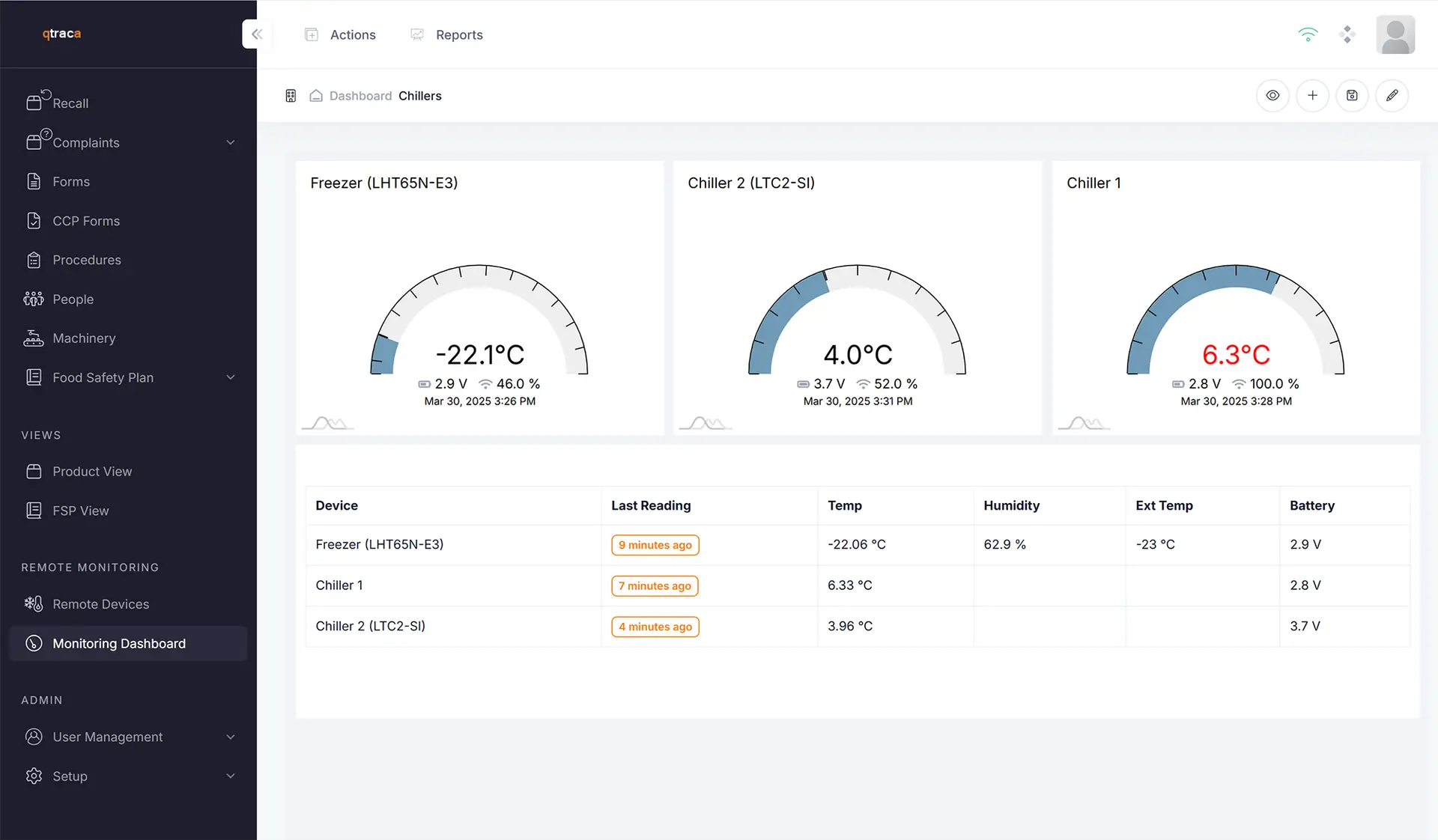
Second, cloud enables capabilities that on-premise can't match: continuous feature deployment, real-time sensor integration across multiple sites, mobile-first workflows on the production floor, automatic disaster recovery, and zero-cost scaling as customers add sites or staff.
If your operation is the 5% that genuinely needs on-premise — air-gapped, specific data residency, legacy integration — QTRACA is not the right vendor for you. SafetyChain and a few others offer on-premise options. Our software-only and cloud-only positioning means we're a sharper fit for the cloud-suitable 95% than vendors who serve both deployment models.
Continue Reading
- How to Choose Food Safety Software — the 12 questions every manufacturer should ask.
- The 2026 Food Safety Software Buyer's Guide — comprehensive reference covering vendor categories, profiles, and methodology.
- Food Safety Software for Small Manufacturers — segment-specific guidance.
- Food Safety Software Pricing Guide — the four pricing models, hidden costs, and TCO comparison.
Cloud vs On-Premise FAQ
See QTRACA's Cloud Platform In Action
Book a 30-minute walkthrough, or start a 15-day free trial with full feature access.