Food Safety Software for Small & Mid-Size Manufacturers
Why enterprise platforms don't fit, what SMB manufacturers actually need, and how to deploy modern food safety software in 2-6 weeks for under $500/month.
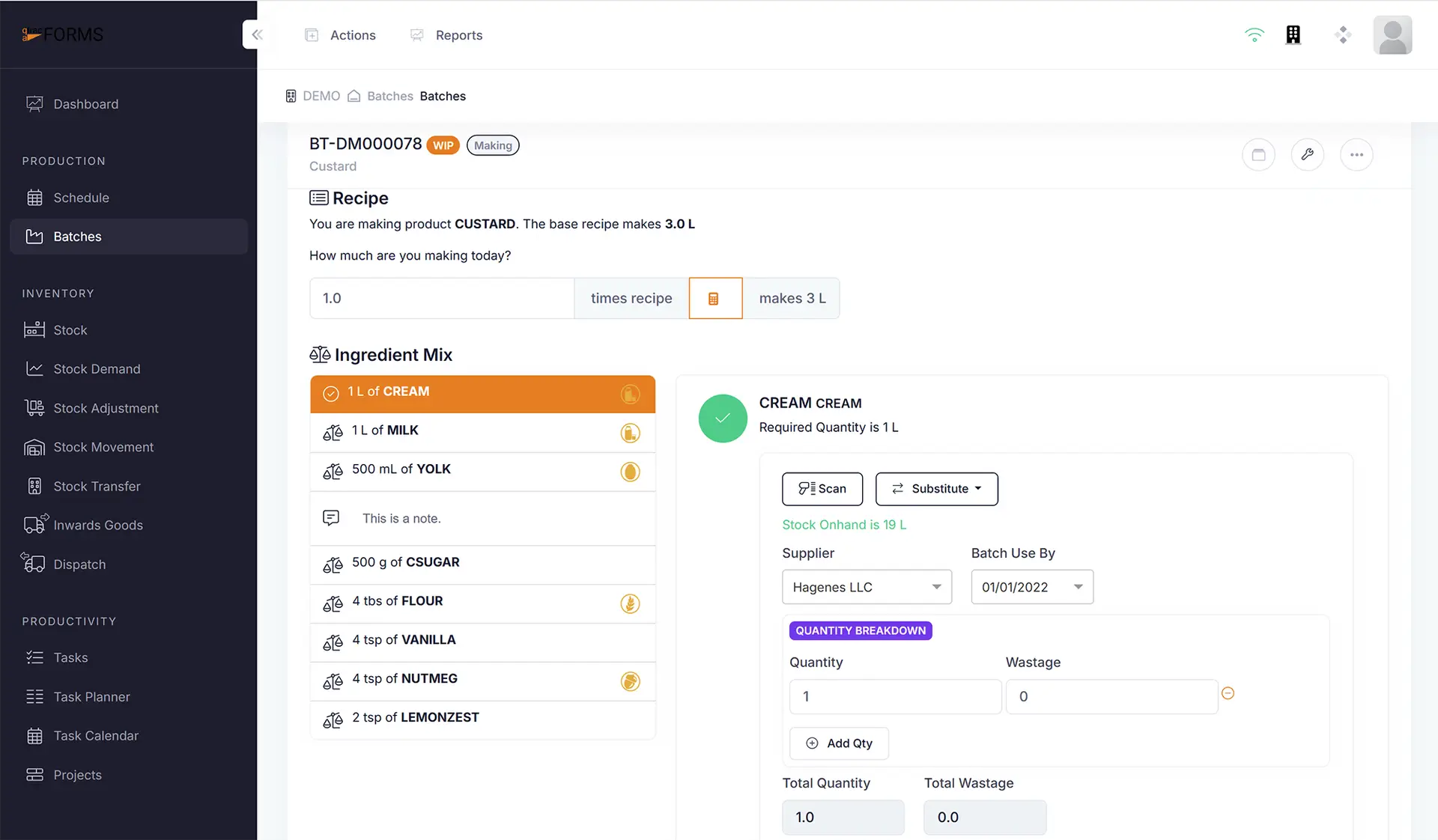
Why Small Food Manufacturers Struggle with the QMS Decision
Small and mid-size food manufacturers face a software market that wasn't built for them. The market shape that pushes SMB into a bad decision:
Enterprise platforms quote $50,000-$200,000 deployments with 6-month implementations, dedicated success managers, and contracts that lock you in for 3 years. These platforms are excellent for large multi-site operations but ruinously expensive for a 15-person creamery or a 25-staff ready-meal manufacturer.
Generalist workplace platforms market themselves as "good enough" for food safety at $24-$30/user/month. They handle daily checks adequately but lack manufacturing-specific depth: recipe management, batch traceability, allergen-aware production, mock recall workflows. SMB buyers who pick generalist platforms typically rebuild on a specialist platform within 18-24 months.
Spreadsheets and paper still run most SMB food safety operations — not because manufacturers prefer them, but because the alternatives felt too expensive, too complex, or too enterprise. The result: paper records that fail audits, lost paperwork, transcription errors, and reactive scrambling when something goes wrong.
There's a third path that's emerged in the last few years: SMB-native platforms built specifically for small-to-mid food manufacturers. Transparent pricing under $500/month. Self-serve trials. 2-6 week implementation. Manufacturing-specific depth without enterprise complexity. This guide is about that path.
Five Capabilities That Matter for Small Manufacturers
The features list at most food safety vendors is overwhelming. For SMB manufacturers, five capabilities matter most. Everything else is either nice-to-have or built for operations larger than yours.
1. HACCP plan modelling that's structured, not just stored
"HACCP support" often means "we have a PDF storage feature." What you actually need is structured CCP records: critical limits encoded as data, monitoring procedures linked to specific control points, corrective actions logged against the CCP they relate to, and verification reports generated automatically. This is the difference between a platform that documents your plan and a platform that operates it. See our HACCP Software page for what good HACCP modelling looks like.
2. Traceability from supplier to customer in one continuous chain
Ingredient lot → production batch → finished good → customer shipment. When a supplier issues a recall notification, you need to identify every affected batch and every customer in minutes, not days. SMB manufacturers with multi-system traceability (inventory in one tool, batch records in another, customer shipments in QuickBooks) consistently take 12-48 hours to scope a recall. Integrated platforms do it in seconds. See Recall Management.
3. Allergen management end-to-end (especially for AU/NZ under FSANZ Standard 1.2.3)
For AU/NZ manufacturers, PEAL labelling under FSANZ Standard 1.2.3 became mandatory in February 2024 with the transition period ending February 2026. The requirement is prescriptive: bold formatting, specific allergen names, plain English statements. SMB manufacturers without integrated allergen management often discover compliance gaps at audit. An integrated platform propagates allergens from ingredients through recipes to labels and checks artwork before print. See Allergen & PEAL Compliance.
4. Mobile-first record capture for shop-floor staff
Production-floor workers don't want to walk to an office computer to log a temperature check. They need a tablet or phone with a form that takes 30 seconds to complete, works offline if WiFi drops, and immediately syncs the record back to the central system. Platforms designed for office desktop usage and grudgingly adapted to mobile tend to feel awkward on the production floor. SMB-native platforms typically have stronger mobile workflows because their customers don't have dedicated quality-office staff to handle paperwork.
5. Native integration with your accounting system
For SMB manufacturers in AU/NZ, that's typically Xero, MYOB, or QuickBooks. For US SMB, QuickBooks dominates. Native integrations push purchase orders, supplier invoices, and inventory movements automatically between systems. The alternative — manual data entry into two systems — is the #1 source of inventory discrepancies and the #1 reason SMB quality managers spend evenings on paperwork. See Integrations.
If a platform doesn't deliver all five strongly, it's not built for SMB food manufacturers. It might be built for enterprise (over-featured for you) or hospitality (under-featured for manufacturing). The five capabilities together define the SMB food manufacturing software profile.
What SMB Food Safety Software Costs in 2026
Transparent pricing is the SMB-friendly standard. The realistic ranges:
Platform subscription: $150–$500/month for the software. QTRACA sits at $199/month (single module) or $349/month (both food safety + inventory modules). SafetyChain and FoodReady at the smaller end of their pricing tier are in the $300–$800/month range. FoodDocs is at the very low end ($129/month typical for SMB). SafetyCulture's premium tier is $24/user/month but doesn't include manufacturing-specific depth.
Per-user fees: $15–$30/user/month. For a 15-person manufacturer with 8 staff actively using the system, that's an additional $120–$240/month. Some platforms include unlimited users in the platform fee; many don't.
Sensors (if used): pricing models vary across vendors. Some charge a monthly per-sensor fee ($30–$50/sensor/month including hardware is common at consumer-Bluetooth platforms). Others sell sensor hardware as a one-time purchase with monitoring usage included in the platform subscription up to defined limits — QTRACA falls in this category, with hardware purchased separately and basic monitoring (up to 2 devices per user, 10-minute polling) included in the platform fee. Continuous production monitoring at faster polling is available as a separate purchase. Industrial 915 MHz sensors cost more upfront than consumer Bluetooth but penetrate concrete and metal that consumer Bluetooth doesn't.
Implementation and training: usually included in modern SMB platforms. Watch for vendors that charge separately — "free" platform but $5,000 implementation fees are common in enterprise platforms sold downmarket. SMB-native platforms typically include onboarding as part of the subscription.
Total monthly cost for a typical SMB single-site manufacturer (15 users): $250–$900/month for platform + users, depending on vendor and sensor pricing model. Platforms with transparent pricing and one-time sensor hardware (like QTRACA at $349 platform + ~$300 for 15 users = $649/mo, plus one-time hardware purchase) sit at the lower end. Platforms with monthly per-sensor fees add $150–$500/month on top. Annual total typically $3,000–$10,800 in platform and user fees. Compare to: enterprise platforms at $30,000–$80,000/year for the same site, or paper-based records' invisible cost of audit failures, quality manager evening hours, and recall risk.
For a deeper pricing breakdown including hidden costs, see our Food Safety Software Pricing Guide.
Four Use Cases That Cover Most Small Manufacturers
The single-site manufacturer (5-30 staff)
Family-owned or founder-led operation. One facility, 1-3 product lines, growing customer base. Quality is handled by the founder, an operations manager, or a part-time quality lead. Pain points: paper records, lost paperwork, audit anxiety, manual recall scoping.
What fits: transparent-pricing integrated platform under $400/month. QTRACA single-module ($199) covers food safety only; dual-module ($349) adds inventory. SafetyChain at the small end works but pricing climbs. SafetyCulture works if food safety is your only operational concern but lacks depth.
The growing manufacturer (30-100 staff, scaling fast)
Past the founder-only phase. Dedicated quality manager. Multiple product lines, perhaps multiple shifts. Recently certified or pursuing SQF/BRCGS. Pain points: scaling paper-based processes that worked at smaller size, integrating with new accounting and ERP systems, multi-shift training, sensor monitoring becoming necessary.
What fits: integrated platform with multi-site capability ready for the next site. QTRACA, SafetyChain, FoodReady. Mobile-first matters increasingly as workforce grows. Industrial IoT sensors should be a serious consideration at this scale.
The co-packer or contract manufacturer
Multiple customer brands run through the same facility, each with their own specs, allergen requirements, and customer audits. Allergen segregation is critical because of varied product mixes. Customer audits are frequent.
What fits: platform with strong allergen management, per-customer specification handling, and clean audit reporting. QTRACA's allergen propagation through recipes is built for this. SafetyChain handles co-packing for larger contract manufacturers.
The AU/NZ exporter to the US
Manufacturing in AU or NZ, exporting to US customers. Domestic compliance: FSANZ Standard 1.2.3 (PEAL labelling), MPI RMP (NZ), state-specific requirements (AU). US compliance: FDA Preventive Controls, FSMA 204 Food Traceability Rule if your product is on the Food Traceability List.
What fits: AU/NZ-built platform with explicit FSMA 204 capability. QTRACA was built for this dual-region requirement. See FSMA 204 Software. US-built platforms typically treat AU/NZ compliance as a regional add-on.
What 2-6 Week SMB Implementation Looks Like
Modern SMB cloud platforms deploy in 2-6 weeks for manufacturers with an existing HACCP plan. The realistic timeline:
Week 1: Account setup and structure. Vendor provisions your account. Internal champion (often the quality manager or operations lead) attends a kickoff. HACCP plan structure modelled into the platform: CCPs identified, critical limits configured, monitoring frequencies set.
Week 2: SOPs and document migration. SOPs uploaded or rewritten into the platform's structured format. Supplier specifications and ingredient profiles entered. Recipes and formulas modelled with allergen propagation enabled.
Week 3: Staff training and sensor deployment. All shifts trained on the mobile workflows. Sensors deployed and calibrated if applicable. Test runs against real CCPs to validate the platform captures records correctly.
Weeks 4–6: Parallel run and cutover. Both paper and digital records run in parallel for 2-4 weeks. Quality manager validates that digital records are complete and audit-ready. Paper records retired. First internal audit using digital records to confirm system is production-ready.
This timeline assumes an existing HACCP plan. If you're starting from scratch, add 4-6 weeks of working with an independent food safety consultant to develop the plan itself. The software setup isn't the bottleneck; the plan is.
An Honest Assessment for SMB Buyers
QTRACA is a strong fit for SMB manufacturers if: you're in AU, NZ, or the USA; you have in-house food safety expertise (a quality manager, operations lead with quality background, or an independent consultant); you want transparent pricing without quote-based sales cycles; you have temperature CCPs that benefit from industrial-grade IoT sensors; you're under FSANZ Standard 1.2.3 PEAL requirements or expect to be soon; or you export to the US and need FSMA 204 capability.
QTRACA is not the right fit for SMB manufacturers if: you have no in-house food safety expertise and want bundled HACCP consulting (FoodReady is built for this); you're a very small operation (under 5 staff) where even $199/month feels heavy and FoodDocs at $129 covers your needs; you operate primarily in food service or hospitality rather than manufacturing (SafeFoodPro fits better); or food safety is one of many operational concerns rather than your primary discipline (SafetyCulture's generalist platform fits better).
The next steps are straightforward: book a 30-minute demo against your specific workflow, or start a 15-day free trial with full feature access. No credit card. No sales pressure. If we don't fit, we'll point you toward a vendor that does.
Continue Reading
- How to Choose Food Safety Software — the 12 questions every manufacturer should ask.
- The 2026 Food Safety Software Buyer's Guide — comprehensive reference.
- Cloud vs On-Premise Food Safety Software — deployment model decision.
- Food Safety Software Pricing Guide — the four pricing models and hidden costs.
SMB Food Safety Software FAQ
See QTRACA In Action
$199/month single module. $349/month both modules. $20/user. No quote-based games. 15-day free trial.