How to Choose Food Safety Software That Actually Works
A practical framework for evaluating food safety software in 2026. The 12 questions every manufacturer should ask, the trade-offs that matter, and the red flags to walk away from.
Why This Decision Matters More Than Most Software Choices
Most software decisions are reversible. Bad CRM? Switch vendors in six months and migrate the contact list. Bad email tool? Cancel and try the next one. Food safety software is different. Once your HACCP plan, SOPs, monitoring records, supplier specs, and audit history live in a platform, migrating out is a 6–12 month project that no one has the appetite for — and the records are legally required to be retained intact.
The result: a bad food safety software choice creates lock-in that lasts for years. Manufacturers regularly tell us they're stuck on platforms they don't like because the cost of migration exceeds the cost of frustration. Choosing well the first time is significantly cheaper than choosing twice.
This guide is the framework we wish more buyers used. It's written from the perspective of a vendor (QTRACA), so we're not pretending to be neutral — but we've made every effort to be honest about the trade-offs and the cases where another platform is the better fit. The point is to help you decide well, not to sell you our product.
The 12 Questions Every Food Manufacturer Should Ask
Work through these in order. The first three are non-negotiable filters — if a vendor can't answer them well, save your time. The remaining nine are differentiators that determine fit.
1. Does it support your specific audit framework?
SQF, BRCGS, FSSC 22000, ISO 22000, FDA Preventive Controls, USDA HACCP, MPI Risk Management Programme, FSANZ — each has different recordkeeping requirements. Generic compliance claims are not enough. Ask the vendor to walk you through a specific verification report for your framework. If they can't, the software wasn't built with your auditors in mind.
2. Can it model your HACCP plan as structured data?
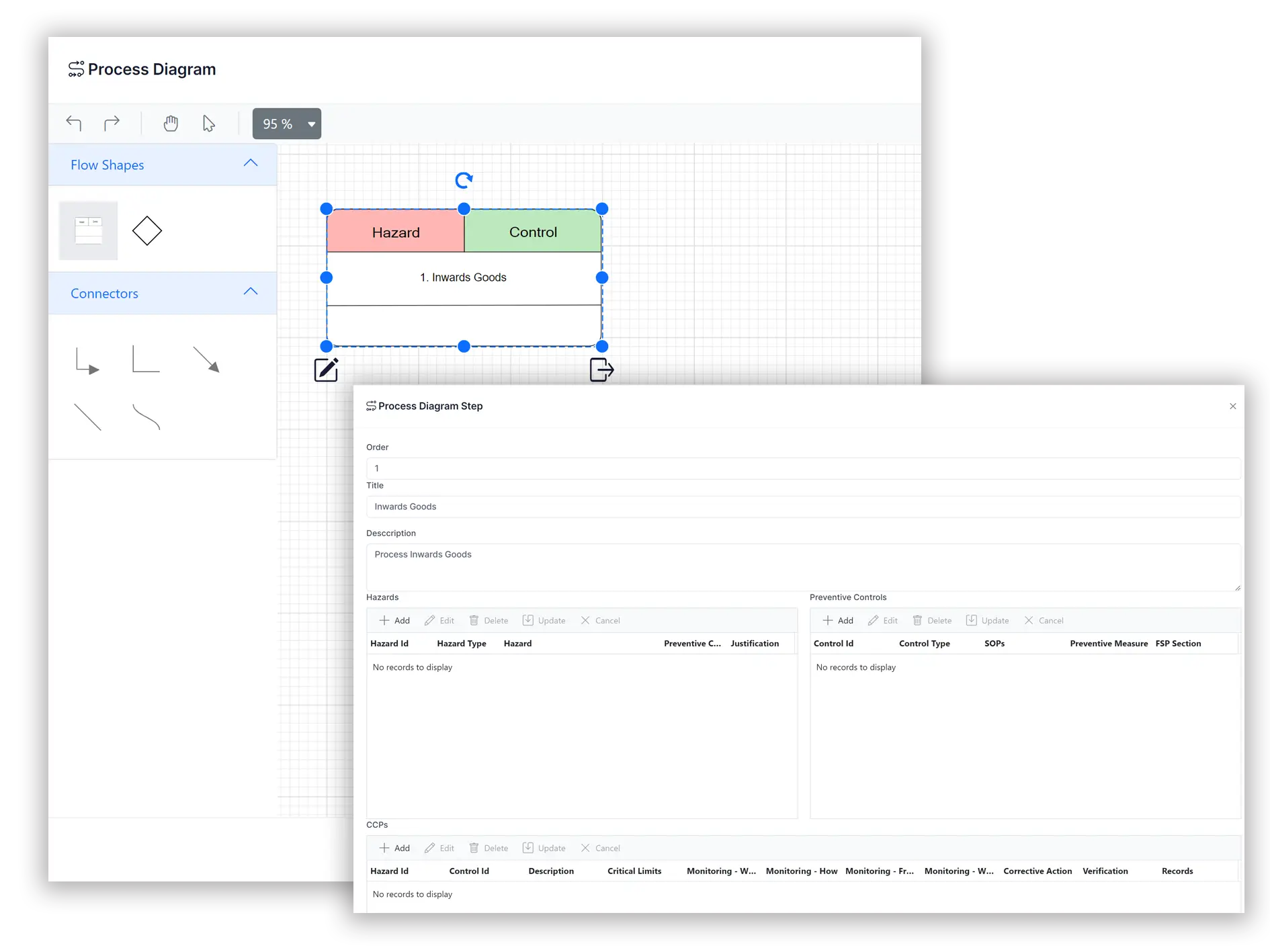
"HACCP support" can mean many things. The real question: does the software model your CCPs, critical limits, monitoring procedures, and corrective actions as linked structured data, or is it just storing a PDF of your plan with form-style records bolted on? The former gives you automatic validation against critical limits; the latter is digital paperwork. See our HACCP Software page for what good HACCP modelling looks like.
3. Does traceability span from supplier to customer?
Ingredient lot → production batch → finished good → customer shipment, in one continuous chain. Anything less and your recalls will be over-scoped because you can't prove which batches were affected. Demand a demo of: enter a supplier lot code, see every finished good and customer it touched. If the demo takes more than a minute, the system isn't built for fast recall.
4. Cloud or on-premise?
For 95% of food manufacturers in 2026, cloud is the right answer. Faster deployment, no IT burden, multi-site capable, mobile-ready, integrates with sensors and accounting. On-premise still makes sense for air-gapped facilities or specific data-residency mandates. Read our Cloud vs On-Premise Guide for the full trade-off analysis.
5. How does CCP monitoring actually work?
Manual entry on a tablet? Sensor-driven? A mix? For temperature CCPs especially, sensor-driven monitoring eliminates transcription errors and catches deviations in real time. Look at whether the platform uses industrial wireless protocols (915 MHz) appropriate for manufacturing environments or consumer-grade Bluetooth designed for offices. Our Cold Chain Monitoring page explains why this matters.
6. What's the recall workflow?
Recalls compound costs by the hour. Ask: from a supplier recall notification, how fast can the system identify every affected batch, finished good, and customer? Modern platforms do this in seconds; legacy systems require manual cross-referencing across multiple databases. Mock recall capability (a requirement for SQF and BRCGS audits) should be built in. Our Recall Management page covers what good looks like.
7. How is allergen management handled end-to-end?
For AU/NZ manufacturers, PEAL labelling under FSANZ Standard 1.2.3 is now mandatory and the requirements are prescriptive. Ask: does the platform link ingredient allergen profiles through recipes to finished labels? Does it check label artwork against the recipe-derived allergen profile before print? Is there a workflow for cleaning validation between allergen-conflicting batches? See our Allergen & PEAL page.
8. How does it integrate with your existing systems?
The platform that lives in isolation creates more work, not less. Common integrations to ask about: accounting (Xero, MYOB, QuickBooks for AU/NZ; QuickBooks for US), ERP, customer-facing portals, and any existing sensor hardware. Native integrations are far better than "we have an API" — the API claim usually means a custom integration project at your cost.
9. Is the pricing transparent or quote-based?
Transparent published pricing means you can evaluate cost before committing to a sales process. Quote-based pricing means the vendor adjusts price based on perceived ability to pay. Neither is automatically wrong: enterprise deployments may legitimately need custom pricing. But for small-to-mid manufacturers, transparent pricing under $500/month is now the norm. Our Pricing Guide covers the four pricing models.
10. What does implementation actually look like?
Ask for a specific timeline with milestones, not "2–4 weeks typically." A good vendor can describe what week 1, week 2, week 3 look like. Look for: structured onboarding, dedicated implementation contact, training materials, and a clear handoff when you're production-ready. Implementation is where most software projects fail; the vendor's discipline here predicts the next two years of your experience.
11. Is consulting bundled or sold separately?
Some vendors (FoodReady is a notable example) bundle HACCP consulting, plan building, and audit prep into their pricing. Others (QTRACA included) sell software only and recommend you work with an independent consultant if needed. Bundled consulting is valuable if you have no in-house food safety expertise; it's overpriced if you do. Be honest about which profile you fit.
12. Can you actually try the software?
A 15-day free trial with full feature access is the gold standard. A 30-minute focused demo is acceptable. A 90-minute discovery call before any product access is a sign of enterprise sales motion — fine for very large buyers, frustrating and slow for SMB. The willingness to let you try the product is one of the strongest signals of vendor confidence.
Five Decisions Where Reasonable Buyers Disagree
Beyond the 12 questions, five higher-level choices shape which vendors are viable. There are no universally right answers — the right answer depends on your operation.
Specialist vs generalist. Specialist food-manufacturing platforms (QTRACA, SafetyChain, FoodReady) tend to handle HACCP, traceability, and food-specific compliance better. Generalist workplace-operations platforms (SafetyCulture) tend to be more flexible across non-food domains and cheaper at small scale. If food safety is your only operational concern, go specialist. If your team also manages WHS, facility checks, and general operations, generalist may be enough.
Manufacturing-first vs hospitality-first. Some platforms (SafeFoodPro, FoodDocs) grew up serving cafes, restaurants, and food service, then expanded into manufacturing. They handle daily food safety checks well but often lack the depth for manufacturing-specific needs like recipe management, batch traceability, and recall workflows. If you manufacture rather than serve food, manufacturing-first platforms will fit better.
AU/NZ-built vs US-built. Regional origin shapes compliance fit. AU/NZ-built platforms (QTRACA, SafeFoodPro, SafetyCulture) handle FSANZ Standard 1.2.3 PEAL labelling, MPI Risk Management Programme, and AU/NZ-specific workflows natively. US-built platforms (FoodReady, SafetyChain, Trustwell) handle FDA, FSMA 204, USDA HACCP natively and treat AU/NZ as a regional add-on. For exporters operating across both regions, choose a vendor that demonstrates active competence in every region you operate in.
Bundled consulting vs software-only. Already covered above but worth restating: if you have no in-house food safety expertise and prefer one vendor for software + consulting, bundled models are valuable. If you have your own expertise or work with an independent consultant, software-only models are usually 30–50% cheaper. The bundled model is not universally better, just suited to a different buyer profile.
Industrial IoT vs office-grade IoT. Most food safety platforms with sensor monitoring use consumer Bluetooth (2.4 GHz). Bluetooth works well in offices and hospitality. In manufacturing environments — with concrete walls, refrigeration compressors, metal-clad cool rooms, and EMI from machinery — consumer Bluetooth degrades significantly. Industrial wireless protocols (915 MHz) are engineered for that physics. If you're doing manufacturing rather than restaurant operations, industrial IoT matters more than vendors usually disclose.
Five Signs to Walk Away
Quote-based pricing for small buyers. If a vendor refuses to publish pricing for under-100-staff manufacturers, the pricing model is opaque by design. Often this means pricing varies based on perceived ability to pay rather than features or scale.
“Yes we do that” without specifics. Generic compliance claims (“we support all major food safety frameworks”, “we handle traceability”) are vendor marketing. Specific demonstrations (“here is how we model an SQF Level 2 verification report for a ready-meal manufacturer”) are vendor competence. If the answers are always at the marketing level, the depth isn't there.
Multi-year contracts as the standard. Annual renewals are the norm in modern SaaS. Multi-year contracts with steep early-termination fees signal that the vendor's retention strategy is the contract rather than the product. If the software is good, an annual renewal is sufficient.
No free trial or self-serve demo. Vendors confident in their product let you try it. If every product evaluation requires a 60+ minute discovery call, the sales motion is built around guiding you toward a contract rather than helping you evaluate.
HACCP capability that's clearly bolted on. Platforms that started as document management, workplace safety, or hospitality compliance and “added” HACCP tend to handle it as form templates rather than structured plan modelling. The tell: ask for a CCP decision tree workflow with linked critical limits. If the answer is “we provide a template you can customize”, that's bolted-on. If the answer is “here's how we model your hazard analysis with linked CCPs”, that's first-class.
An Honest Self-Assessment Against This Framework
Applied to the framework above, QTRACA fits some buyer profiles well and others poorly. We'd rather you find that out from this page than after a wasted sales process.
QTRACA is a strong fit for: small-to-mid food manufacturers in Australia, New Zealand, and the United States; operations with cook, cool, or storage CCPs that benefit from industrial IoT monitoring; teams that have in-house food safety expertise or work with an independent consultant; manufacturers under FSANZ Standard 1.2.3 PEAL labelling requirements; operations seeking transparent pricing ($199/month single module, $349/month both modules, $20/user) and an annual renewal model.
QTRACA is not the right fit for: very large enterprise food manufacturers that need real-time SPC and PLC integration (SafetyChain handles this better); manufacturers with no in-house food safety expertise that want bundled HACCP consulting (FoodReady is built for this); hospitality operations that need a daily-checks platform rather than manufacturing-grade traceability (SafeFoodPro fits better); operations whose primary need is general workplace operations across many domains rather than deep food safety (SafetyCulture fits better).
If after working through the framework you think QTRACA fits, the next steps are easy: book a 30-minute demo or start a 15-day free trial. If after working through the framework another platform fits better, that's a good outcome too — the framework saved you from a bad decision.
Related Guides
This is the anchor guide. For deeper dives on specific decision points, see:
- The 2026 Food Safety Software Buyer's Guide — comprehensive 3,000-word reference covering categories, vendor types, and evaluation methodology.
- Cloud vs On-Premise Food Safety Software — architecture decision in detail with the trade-off matrix.
- Food Safety Software for Small & Mid-Size Manufacturers — segment-specific guidance for SMB.
- Food Safety Software Pricing Guide — the four pricing models, hidden costs, and TCO comparison.
FAQ: Choosing Food Safety Software
See QTRACA Against Your Framework
Book a focused 30-minute walkthrough, or start a 15-day free trial with full feature access. No credit card required.