QTRACA vs FoodReady
A practical comparison for food manufacturers choosing between two food-specific platforms with different approaches: software-first with transparent pricing and industrial IoT, or consulting-led with bundled expert support and quote-based pricing.
Is QTRACA an alternative to FoodReady?
Yes. Both are purpose-built food platforms covering HACCP, traceability, inventory, and supplier management, so the comparison is genuinely peer-to-peer rather than category-level. The choice comes down to three real differences: how the products are bought (quote-based with bundled consulting vs published pricing for self-serve buyers), what IoT they include (no proprietary sensor hardware vs an industrial 915 MHz network plus Bluetooth Thermapen integration with automatic CCP validation), and which regulatory regions they prioritise (US-anchored with strong FSMA 204 and FDA consulting vs AU/NZ-built with FDA, USDA, MPI, and FSANZ coverage).
If you are a US food manufacturer that wants bundled expert consulting to build a HACCP plan from scratch or prepare for an SQF audit, FoodReady's consulting-led model is genuinely well-suited to you. If you want transparent published pricing, industrial wireless sensors that auto-validate against your HACCP CCPs, and a platform built for AU, NZ, and US regulatory frameworks, QTRACA is built for that work. This page walks through where each is genuinely stronger.
Both platforms in one paragraph each
FoodReady
FoodReady is a US-headquartered food safety, HACCP, and quality management platform, used by more than 1,000 food companies (per their published figures). It combines AI-powered HACCP plan generation, 80+ pre-built plan templates, traceability, inventory and batch management, supplier compliance, and CAPA workflow tracking with a distinctive offering: bundled expert food-safety consultants for HACCP, FDA, SQF, GFSI, GMP, and FSMA 204. Customer base spans seafood processing, coffee roasting, bakeries, kombucha brewers, dairy, and food service operations. Pricing is quote-based; a 14-day free trial is available.
Source: foodready.ai
QTRACA
QTRACA is a cloud-based platform purpose-built for food manufacturers, designed in New Zealand and serving customers across Australia, New Zealand, and the USA. From day one it has combined manufacturing HACCP, inventory management (receiving, batches, WIP, finished goods), end-to-end traceability, recipe management, allergen and PEAL compliance, IoT temperature monitoring, supplier certificate management, and AI-assisted features including AI Label Review and AI SOP Generation. It is built for businesses that take ingredients in, make a product, and ship it out under the Risk Management Programme (RMP), National Programme (NP), or for export.
Where QTRACA is built differently
Transparent published pricing vs quote-based with bundled consulting
Both QTRACA and FoodReady are food-specific platforms. The first real difference is in how they are sold. FoodReady is sold through a consultative process and pricing is quote-based — their pricing page lists three plans but does not publish numbers. Capterra and third-party reviews note that FoodReady pricing "may be high for small single-site operations" and that "implementation may require training and consulting input."
QTRACA publishes its pricing transparently. There is no quote process to start an evaluation; the numbers are on the page. For self-serve buyers who want to know what software costs before booking a sales call, this matters.
The published QTRACA pricing:
Single module
(food safety or inventory): $199 per month, first user included
Both modules
(food safety and inventory): $349 per month, first user included
Additional users
$20 per user per month
15-day free trial
, no credit card required
For buyers who value bundled expert consulting and are willing to engage in a sales process to scope it, FoodReady's consulting-led model is a real strength. For buyers who want to evaluate, pilot, and adopt a platform without a sales cycle, QTRACA's self-serve model is built for that.
Different AI features for different jobs
Both platforms include AI features, but they focus on different parts of the food manufacturing workflow. FoodReady's AI is concentrated on HACCP plan generation: an AI-powered drag-and-drop process flow designer with click-and-choose hazard database, automatic CCP mapping, and 80+ pre-built HACCP and Preventive Control Plan (PCP) templates. For a manufacturer building a HACCP plan from scratch, that is a real accelerator.
QTRACA's AI focuses on different tasks: AI Label Review checks finished product labels against ingredient declarations and allergen rules, flagging mismatches before product ships — directly relevant to PEAL compliance and packaging accuracy. AI SOP Generation produces draft Standard Operating Procedures from a library of food-safety topic templates aligned to NZ, AU, and US regulations, accelerating SOP work that would otherwise take days. QTRACA also models HACCP plans with CCP definitions and decision trees, but its AI emphasis is on the day-to-day admin load (labels, SOPs) rather than initial plan generation.
Sensor data flows directly into forms and validates against CCPs
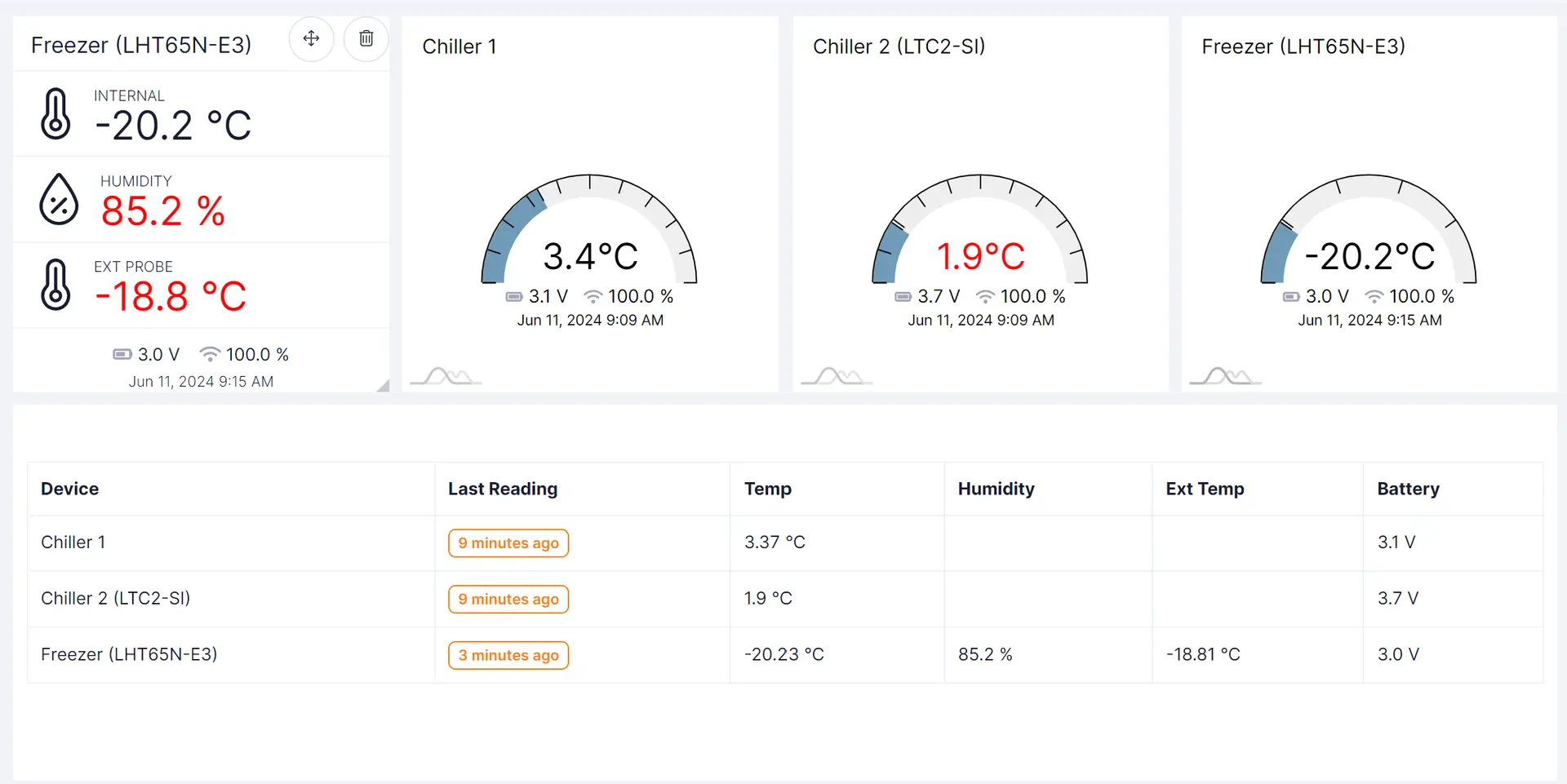
QTRACA's IoT integration goes well beyond saving point-in-time temperature readings. Sensor data — temperatures, humidity, cook and cool curves — streams directly into the relevant form, where it is automatically recorded and graphed against the Critical Control Point (CCP) limits in your HACCP plan.
For a food manufacturer running cook or cool cycles, this means:
Cook temperatures and times
Recorded automatically as they happen, with the full curve visible on the form for verification
Cool-down curves
Graphed against time-temperature requirements (for example, the 60°C to 21°C drop within a defined time window)
Automatic CCP validation
The form flags any time, temperature, or curve that fails to meet the CCP in your HACCP plan, so deviations are caught in real time rather than discovered at audit
No manual transcription
Staff are not copying sensor readings onto paper or typing them into forms
QTRACA gives you the right wireless protocol for each measurement point. For continuous monitoring on the production floor, QTRACA's 915 MHz industrial wireless sensor network is engineered for the signal penetration challenges of food manufacturing: thick concrete walls, refrigeration units, metal-clad equipment, and electromagnetic interference from heavy machinery. For handheld spot checks, QTRACA integrates directly with Bluetooth Thermapen probes, with probe readings flowing straight into forms.
FoodReady's Monitoring feature lets users view CCP and operational monitoring programs in one place and supports real-time data capture, but FoodReady does not appear to ship its own wireless sensor hardware. Their monitoring works through manual data entry and integrations rather than a proprietary sensor network. For food manufacturers that want sensor hardware bundled with the software, QTRACA includes that capability natively; FoodReady customers typically source sensors separately and feed data into FoodReady via integrations or manual entry.
For a manufacturer running cook or cool cycles where time and temperature are critical control points, this difference is operational. QTRACA's sensor-to-form-to-CCP pipeline catches deviations as they happen; without bundled sensor hardware, equivalent monitoring requires sourcing and integrating third-party sensors with FoodReady.
Multi-region regulatory coverage built in
FoodReady is US-anchored. Its regulatory and audit consulting expertise is concentrated on FDA, USDA, FSMA 204, and the major North American certifications (SQF, BRCGS, GFSI, FSSC 22000, ISO 22000). For a US-only food manufacturer, that focus is a strength — you get specialists who know the regulatory landscape you operate in.
QTRACA is built for food manufacturers in Australia, New Zealand, and the United States. It supports the same global certifications (SQF, BRCGS, GFSI, FSSC 22000, ISO 22000) plus the regulatory frameworks specific to AU and NZ: New Zealand's Risk Management Programme (RMP), National Programme (NP), and Food Control Plan (FCP) under the Food Act 2014; Australia's FSANZ-aligned food safety requirements; PEAL (Plain English Allergen Labelling) compliance; and MPI (Ministry for Primary Industries) verification workflows for export-grade traceability.
For a food manufacturer that exports between regions, or operates in AU/NZ with US customers, this multi-region coverage matters. For a US-only manufacturer that wants deep consulting on FSMA 204 specifically, FoodReady's US-focused consultants are likely the stronger choice.
Where FoodReady is the stronger choice
A comparison page that claims the alternative wins on everything is not a comparison — it is an advertisement. Here is where FoodReady genuinely beats QTRACA, and where you should consider it instead:
Bundled expert food-safety consulting
FoodReady's strongest differentiator is genuine: they bundle certified food-safety consultants as part of the product. HACCP consultants, FDA consultants, SQF consultants, GFSI consultants, GMP consultants, and FSMA 204 consultants are all on offer. For a food manufacturer that is preparing for a first-time SQF or BRCGS audit, building a HACCP plan from scratch, or navigating FSMA 204 compliance without internal expertise, this hands-on support is a real advantage. QTRACA is software-first — we provide documentation, onboarding, and the platform itself, but we do not staff a consulting bench.
AI HACCP Plan Builder with 80+ templates
FoodReady's AI HACCP Plan Builder is specifically tuned for generating HACCP plans from scratch. It includes a drag-and-drop process flow designer, a click-and-choose hazard database, automatic CCP mapping, and over 80 pre-built HACCP and Preventive Control Plan templates across industries (agriculture, dairy, distribution, beverages, seafood, grains, soups and sauces, candy, oils and nuts, proteins, transportation, and more). For a manufacturer building a HACCP plan for the first time with no template starting point, this is a significant accelerator. QTRACA models HACCP plans natively but does not currently match FoodReady's template library volume.
US regulatory depth and FSMA 204 consulting
FoodReady is US-headquartered with deep specialisation in FDA, USDA, and FSMA 204 compliance. Their FSMA 204 consultants specifically support manufacturers preparing for the Food Traceability Rule's Critical Tracking Events (CTEs) and Key Data Elements (KDEs) requirements that come into force in 2026. For a US-only food manufacturer that wants expert consulting alongside the software on FSMA 204 specifically, FoodReady's US-anchored expertise is genuinely the stronger choice. QTRACA supports FSMA 204 in the platform but does not provide bundled consulting on US-specific compliance.
Larger US customer base and market familiarity
FoodReady has more than 1,000 customers (their published figure) with a strong concentration in US food manufacturing across seafood, coffee, bakery, dairy, kombucha, and similar categories. For prospects who value seeing a vendor with established US market presence and customer references they can talk to in their region, FoodReady's scale and familiarity is a real factor. QTRACA serves food manufacturers in AU, NZ, and the USA with growing US presence but is a smaller player by absolute customer count.
Consulting-led onboarding for teams without in-house QA
FoodReady's consulting-led onboarding is designed for food manufacturers that do not have a dedicated Quality Assurance or food-safety lead in-house. The consultants will help write the HACCP plan, set up monitoring programmes, develop SOPs, and prepare for the first audit. For a startup, co-packer, or small manufacturer where the founder or operations manager wears the QA hat, this hand-holding can be the difference between deploying successfully and stalling out. QTRACA assumes a baseline of internal QA capability or willingness to engage independent consultants.
Side-by-side
| FoodReady | QTRACA | |
|---|---|---|
| Product category | Food safety + QMS + inventory platform with bundled consulting | Food safety + inventory + traceability platform, software-first |
| Headquarters & regional focus | US-headquartered, US regulatory focus (FDA, USDA, FSMA 204) | AU/NZ-built, serves AU, NZ, and USA (MPI, FSANZ, FDA, USDA) |
| Pricing transparency | Quote-based, not publicly listed | Published: $199/month single module or $349/month both modules, $20 per additional user |
| Bundled food-safety consulting | Yes — HACCP, FDA, SQF, GFSI, GMP, FSMA 204 consultants | No — software-first product with documentation and onboarding support |
| HACCP plan templates | 80+ pre-built HACCP/PCP templates across industries | Food-manufacturing templates aligned to QTRACA's data model |
| HACCP plan modelling | AI-powered drag-and-drop process flow + click-and-choose hazard database | CCP modelling with hazard analysis trees and critical limit validation |
| Inventory & batch management | Yes — production runs, BOM, lots, purchase orders | Yes — receiving, batches, WIP, finished goods |
| End-to-end traceability | Lot-level shipping/receiving logs, FSMA 204 support | Ingredient receipt → batch → finished goods → customer |
| Recall management | Yes — recall plans, mock recalls, recall effectiveness | Yes — batch-level recall isolation and reporting |
| Allergen / PEAL compliance | Allergen control in templates and checklists | Allergen checks on receiving, AI Label Review for PEAL compliance |
| AI features | AI HACCP Plan Builder, automated CCP mapping, monitoring recommendations | AI Label Review, AI SOP Generation |
| IoT sensor hardware | Not advertised as bundled hardware — monitoring works via manual entry or integrations | 915 MHz industrial wireless sensors for continuous monitoring, plus Bluetooth Thermapen probes for handheld checks |
| Sensor → CCP validation | Real-time monitoring of CCP programs (manual or integrated data sources) | Sensor data streams into forms with auto-graphing and automatic CCP validation against HACCP plan limits |
| Mobile experience | Native iOS and Android apps | Progressive Web App (PWA): installable, offline-capable, tablet-optimised for production floors |
| Accounting integrations | QuickBooks | Xero, MYOB, QuickBooks |
| Free trial | 14-day free trial | 15-day full-feature trial, no credit card |
FoodReady information sourced from foodready.ai and verified third-party reviews on Capterra and SoftwareSuggest. Last reviewed: May 2026.
How much do they cost?
This is one of the clearest differences between the two platforms. FoodReady pricing is quote-based and not publicly listed on their pricing page — you contact sales for a tailored consultation. Their pricing page describes three plans but does not expose specific monthly figures. Third-party reviews (Capterra, SoftwareSuggest) note that FoodReady pricing "may be high for small single-site operations" and that "implementation may require training and consulting input."
QTRACA pricing is published and transparent:
The honest read on pricing:
If you want to evaluate before talking to sales
QTRACA's transparent pricing is genuinely easier — you know what the platform costs before you commit to a discovery call. FoodReady's quote-based model requires a sales conversation to surface numbers.
If you want bundled consulting
FoodReady's pricing includes access to expert food-safety consultants who help build your HACCP plan, prepare audits, and write SOPs. That bundled expertise is part of what you are paying for and is genuinely valuable if you need it.
If you have in-house QA or work with independent consultants
QTRACA's software-only pricing is usually the more cost-effective path because you are not paying for consulting capacity you would not use.
For most food manufacturers, the real question is not "which is cheaper" but "which model suits how I want to buy and use the platform." For buyers who want a transparent, self-serve evaluation, QTRACA. For buyers who want a consultative onboarding with bundled expertise, FoodReady.
Which is right for you?
Choose FoodReady if you...
- Are a US food manufacturer and want deep FDA, USDA, and FSMA 204 regulatory consulting
- Need to build a HACCP plan from scratch and want an AI HACCP Plan Builder with 80+ pre-built templates
- Are preparing for a first-time SQF, BRCGS, GFSI, FSSC 22000, or ISO 22000 audit and want expert consultants to help
- Do not have a dedicated Quality Assurance or food-safety lead in-house
- Prefer a consultative sales process with custom-quoted pricing
- Want a US-anchored vendor with established North American customer base
- Are willing to engage in a sales process to scope the right plan
Choose QTRACA if you...
- Want to see published pricing before committing to a sales call
- Operate in AU, NZ, or across AU/NZ/US and need multi-region regulatory coverage (MPI, FSANZ, FDA, USDA)
- Want bundled industrial 915 MHz wireless sensors and Bluetooth Thermapen probe integration
- Need automatic CCP validation as sensor data streams into forms (with auto-graphing of cook and cool curves)
- Have allergen and PEAL compliance obligations on AU/NZ manufactured product labels
- Use Xero or MYOB (in addition to QuickBooks) for accounting
- Have in-house QA expertise or work with independent food-safety consultants
- Value AI features for daily admin (Label Review, SOP Generation) rather than initial HACCP plan generation
- Want a tablet-friendly Progressive Web App for production floor staff (installable, offline-capable)
- Prefer a self-serve evaluation: 15-day free trial, no credit card, no sales cycle required
QTRACA vs FoodReady FAQ
See if QTRACA is the right fit for your operation
Book a 30-minute walkthrough, or start a 15-day free trial with full feature access. No credit card required.
Related Reading
Still evaluating food safety software?
Beyond head-to-head comparisons, our How to Choose Food Safety Software guide walks through the 12 questions every food manufacturer should ask, the five trade-offs that matter, and the red flags to watch for.
For a comprehensive reference covering vendor categories, manufacturer profiles, pricing models, and implementation timelines, see the 2026 Food Safety Software Buyer's Guide — or jump to the Pricing Guide for cost comparisons.